Historical background: Cobb--Douglas and factor shares
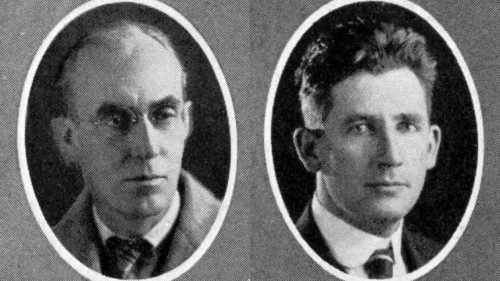
Charles Wiggins Cobb and Paul Howard Douglas
Charles Wiggins Cobb (1875--1949) was an American mathematician and Amherst College graduate who taught there from 1906 to 1948. He brought mathematical expertise to the collaboration with Douglas; their 1928 paper joined a tractable production function to evidence on U.S. manufacturing. Amherst's archive preserves his manufacturing data and reports alongside his mathematical work.
Source: Amherst College Archives.
Paul Howard Douglas (1892--1976) was an American economist and professor of industrial relations at the University of Chicago. His interest in wages, production, and factor incomes motivated the empirical question behind their joint work. He later represented Illinois in the U.S. Senate (1949--1967), where he chaired the Joint Economic Committee. His career connected economic research with public service.
Sources: U.S. Congress biography; Douglas (1967, pp.~15--16).
Where did the Cobb--Douglas production function come from? It began as an attempt to measure the relationship between production and its inputs. The economist Paul Howard Douglas (1892--1976) from the University of Chicago (later a U.S. Senator) was interested in the regularity of the aggregate labor and capital shares of income in the U.S.. During a 1927 visit to Amherst, he showed the data to Charles Wiggins Cobb (1875--1949), a mathematician. Douglas was looking for a mathematica function that would be consistent with the patterns in the data. Their collaboration let to the 1928 paper Cobb and Douglas (1928), which introduced the Cobb--Douglas production function. See also Amherst College's Charles Wiggins Cobb archival record and the U.S. Congress biography of Paul Howard Douglas. Douglas's own account of Cobb's mathematical role is in Douglas (1967, pp.~15--16).
The fact that the labor and capital shares of income were approximately constant over time turned out to be quite consequential. Within the competitive two-input model, stable factor shares despite changing relative factor prices are consistent with an elasticity of substitution near one, holding technology fixed. Stable shares alone do not identify the elasticity when technology and other determinants of factor payments also change. A decade after the Cobb--Douglas paper, Keynes (1939) described the stability of labor's share as "one of the most surprising, yet best-established, facts in the whole range of economic statistics." The question at that time is the same one we have just studied: how can the division of income remain stable while output, input quantities, and prices change?
Nevertheless, the labor share has declined across many countries and industries since the 1980s. Karabarbounis and Neiman (2014) document this broad pattern and estimate that falling relative investment prices account for roughly half of the decline in their model. Their explanation relies on an elasticity of substitution above one: cheaper capital raises its use enough to increase its share of income. Karabarbounis (2024) provides a recent survey of the evidence and competing explanations.
The task-based approach we will look at later in the course offers a different mechanism. Acemoglu and Restrepo (2018) develop a model in which automation transfers tasks from labor to capital and reduces the labor share, while new tasks can reinstate labor. Acemoglu and Restrepo (2019) connect these mechanisms to evidence on changes in the task content of production. These papers help us distinguish automation from capital becoming cheaper or more productive at tasks it already performs.
Changes in the allocation of production across firms also matter. Autor et al. (2020) find evidence consistent with sales shifting toward highly productive "superstar" firms with low labor shares. In their account, the aggregate share can fall through reallocation toward these firms, without a comparable decline at the typical firm.
This cautions against treating all nonlabor income as the competitive return to capital.