Historical background: why economists introduced CES
Solow: Employment and growth
The story of the CES is rooted in the interest of economist to understand how growth can happen when technological change is biased toward one factor. In particular, Solow's 1956 paper (Solow 1956) on growth theory was motivated by the question of whether saving and investment can keep a growing labor force fully employed. As more workers enter the economy, they need capital to work with. Saving finances investment, but will the resulting capital stock provide enough jobs without leaving machines idle?
The issue economists had is that the growth rate consistent with saving and investment need not equal the growth rate consistent with full employment. What if technology is augmenting capital faster than labor? If capital and labor are hard to substitute for each other, the economy may not be able to use all of the capital and labor that is available. We can see this clearly in the extreme case in which capital and labor are perfect complements and the production function is Leontief (as in the pionering work of Harrod (1939) and Domar (1946)):
Production requires fixed amounts \(A_K>0\) of capital and \(A_L>0\) of labor per unit of output. This means that to use all capital and employ all labor, we need \(K/A_K=L/A_L=Y\). In particular, the capital--output ratio must remain \(K/Y=A_K\).
If investment is such that capital accumulation equals a fraction \(s\) of output (the savings rate), then we have that capital grows at rate
That growth rate must be the same as the growth rate of output \(g_Y\) to keep the capital--output ratio constant.
However, full employment requires \(Y\;=\;L/A_L\), which implies that output and labor must grow at the same rate, equal to the population growth rate \(n\):
Sustained growth with both factors fully employed consequently requires the exact equality
Why should household saving behavior, the technological capital requirement, and population growth happen to satisfy this equality? There is no reason in this model for them to do so. This result was concerning for Solow because balanced growth rests on a knife edge: a small change in \(s\), \(A_K\), or \(n\) breaks the compatibility condition.
The answer Solow gave to this problem involved abandoning the benchmark of perfect complements. Under the Leontief technology, a lower wage cannot persuade firms to use more labor per machine. The required ratio \(K/L=A_K/A_L\) is technological, regardless of relative factor prices. Solow challenges this restriction:
"If this assumption is abandoned, the knife-edge notion of unstable balance seems to go with it."
Source and context: Solow (1956, p.~65), *A Contribution to the Theory of Economic Growth, Introduction, printed pp.~65--66 (PDF pp.~2--3)*.
Solow replaces the Leontief production function with a constant-returns-to-scale production function \(\,Y\;=\,F(K,L)\,=\,Lf(k)\), where \(k\,=\,K/L\) and \(f(k)\,=\,F(k,1)\). The same saving and population growth assumptions now give
In steady state, a constant capital--labor ratio \(k^{ss}\) satisfies \(sf(k^{ss})\,=\,(1+n)k^{ss}\). The capital--output ratio can now adjust with \(k\), rather than being fixed at \(A_K\). For example, with the Cobb-Douglas production function we obtain \(f(k)=k^\alpha\), with \(0<\alpha<1\). Then
If \(k<k^{ss}\), capital grows faster than labor and \(k\) rises. If \(k>k^{ss}\), capital grows more slowly than labor and \(k\) falls. A change in \(s\) or \(n\) changes the long-run ratio; it no longer requires that the parameters happen to coincide for there to be long-run growth. Relative wages and rental prices adjust so that firms choose the available input ratio.
So, what do we take from this? We need inputs to be substitutable to obtain balanced growth. The Cobb-Douglas with its elasticity of substitution of one is one case. However, and as we saw above, the Cobb-Douglas does not cover every relevant case.
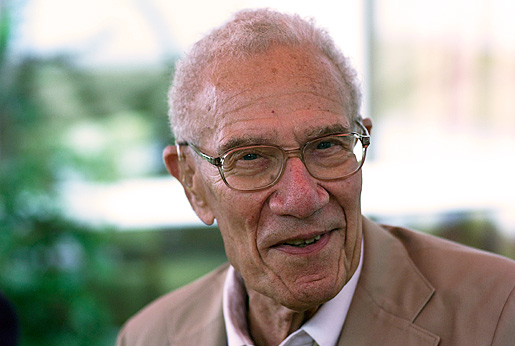
Robert M. Solow (1924--2023)
Solow was an American economist born in Brooklyn. He entered Harvard in 1940, served in the Second World War, and returned to study economics. He joined MIT in 1949 and received the 1987 economics Nobel Prize for his contributions to the theory of economic growth.
His work asked why economies grow and how much of that growth comes from capital accumulation and technological progress. In his 1956 growth model, substitution between capital and labor allowed production to adjust as their relative availability changed. His later collaboration with Arrow, Chenery, and Minhas introduced the CES function. These contributions connect our questions about input substitution to the larger question of how technology changes living standards over time.
Sources: Nobel Prize profile; Solow (1956); Arrow et al. (1961).
Making substitutability an empirical parameter
The CES production function was introduced in 1961 by Kenneth Arrow, Hollis Chenery, Bagicha Minhas, and Robert Solow in Arrow et al. (1961). At the time, applied work was dominated by Leontief technologies with fixed coefficients and Cobb--Douglas production functions. These were not entirely arbitrary benchmarks, but they did constraint results because the elasticity of substitution is fixed at zero for Leontief functions and one for Cobb-Douglas. Arrow, Chenery, Minhas, and Solow wrote:
"From a mathematical point of view, zero and one are perhaps the most convenient alternatives for this elasticity."
They further argued that it would be better to estimate this elasticity rather than impose its value. Their main argument is that there are many economic questions whose answers depend on the value of the elasticity of substitution:
- Can a growing economy keep both factors fully employed? This is the problem highlighted by Solow in his previous work, showing that zero substitution between labor and capital is incompatible with long run employment.
- How do a country's factor supplies affect what it trades? The authors show that the effects of trade depend on this elasticity too, for example implying "reversals of factor intensities at different factor prices." A sector that uses relatively more capital at one wage--rental ratio need not do so at another. Differences in substitution possibilities across sectors can change the ranking and hence conclusions about trade and factor rewards.
- Does labor necessarily receive a constant share of income? They question the "supposed constancy of the labor share." Choosing Cobb--Douglas imposes constant competitive shares. Whether shares are approximately stable, and what explains that stability, are empirical questions rather than reasons to impose the answer in advance.
Source and context: Arrow et al. (1961), printed p.~225 (PDF p.~2), examples (i)--(iii).
At the core of the questions posed by these economists is that we want to attribute differences in output to capital, labor, and technological knowledge. But what if the production function used for that decomposition was wrong? Arrow put it this way:
"I had speculated that the decomposition might be faulty if the wrong production function were used, but I had done little about it."
Source and context: Arrow (1979), one-page *Citation Classic retrospective*, first two paragraphs of Arrow's account. The statement is dated December 27, 1977 and was published on April 23, 1979.
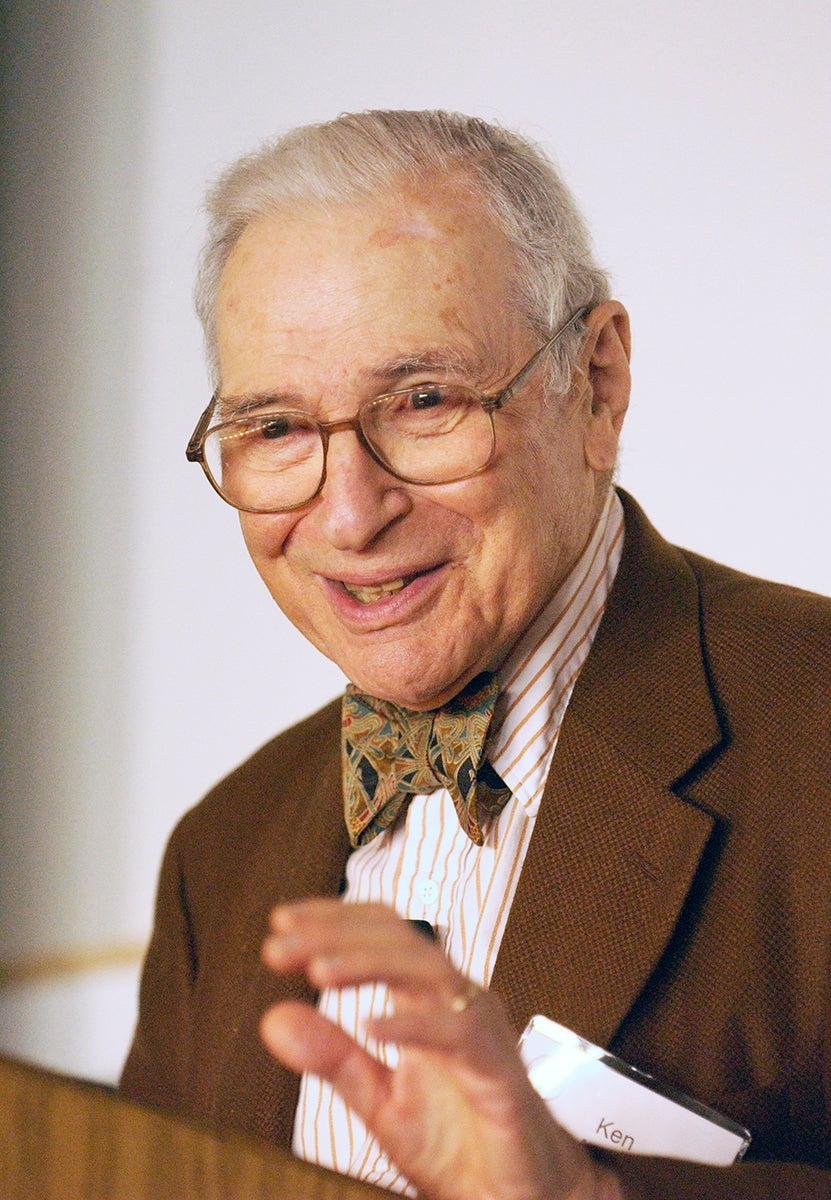
Kenneth J. Arrow (1921--2017)
Arrow was an American economist born in New York. He studied mathematics at City College and Columbia, moving into economics under Harold Hotelling's influence. Research at the Cowles Commission and RAND helped shape his work on social choice and economic efficiency. He taught at Stanford and Harvard and shared the 1972 economics Nobel Prize with Hicks for contributions to general equilibrium and welfare theory.
His research asked how individual choices fit together, when markets allocate resources efficiently, and how information changes economic decisions. His impossibility theorem identified limits to combining individual preferences into a collective ranking. For this lecture, his collaboration with Chenery, Minhas, and Solow matters because it made the elasticity of substitution a parameter to estimate. His later work on innovation and learning by doing also connects to our study of technology.
Sources: Arrow's Nobel autobiography and 2005 addendum (Nobel Lectures, Economics 1969--1980); Nobel Prize profile; Arrow et al. (1961).