Isoquants and the marginal rate of transformation (MRT)
How do we know when we have moved to the right combination of capital and labor? The answer comes from examining the cost minimization problem more closely. We will get to the graph in a moment, but first we stick with the mathematical derivations we have to characterize the defining property of the isoquant embodied in the marginal rate of transformation (MRT). Taking a total differential of the constraint gives
Therefore the slope of the isoquant is,
This slope is a special concept for all the topics that follow because it directly measures how much you have to exchange capital and labor to keep output constant. The concept is so important that we give it a name.
Definition 1.3: Marginal rate of transformation (MRT)
The marginal rate of transformation of labor for capital is
It is the amount of capital that can be removed when labor rises by one small unit while keeping output unchanged.
The MRT is a local concept. It answers a question about a small movement from the firm's current input mix. If \(\operatorname{MRT}_{L,K}=2\), then near that point one additional unit of labor allows the firm to use approximately two fewer units of capital without changing output. In consumer theory the analogous object is called the marginal rate of substitution (the ratio of the marginal utilities).
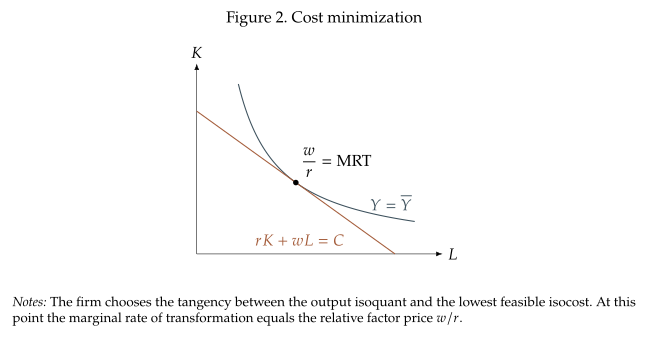
Equation (1.23) now has a visual interpretation. An isocost line has slope \(-w/r\) when \(K\) is on the vertical axis. At the cost-minimizing point, the isoquant has the same slope. If labor becomes more expensive relative to capital, the isocost becomes steeper and the firm moves toward a more capital-intensive technique.