Historical background: Wassily Leontief
Finally, it is worth mentioning the work of Wassily Leontief on production networks. His work greatly influenced how we think about the way production is organized in the economy. From the point of view of this course, his most salient contribution is what we call the Leontief function which captures perfect complements. This function implies an elasticity of substitution of zero (\(\sigma=0\)) so that the ratio of inputs does not change with prices. This key feature means that the ratio of inputs is constant and given entirely as a property of production.
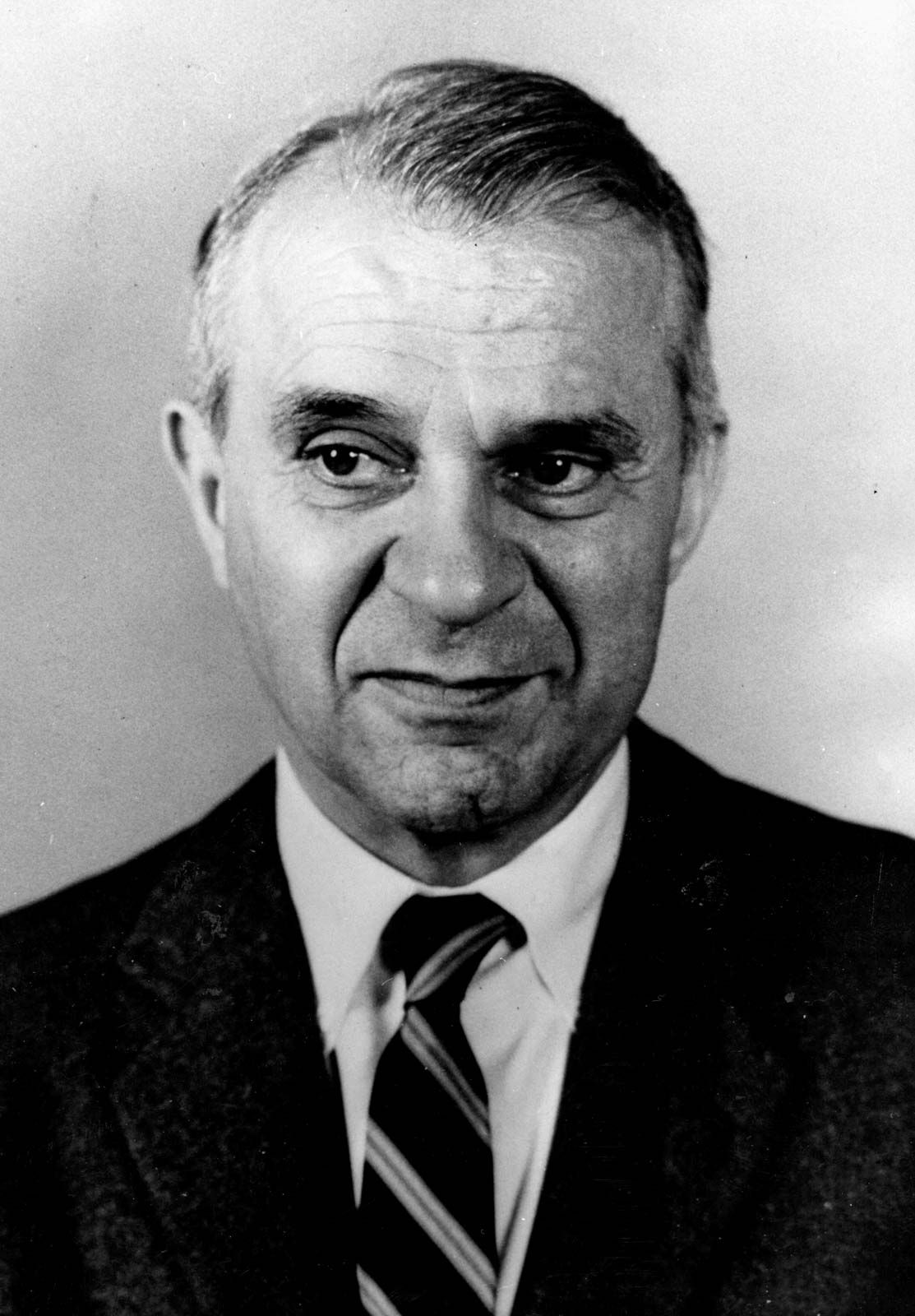
Wassily W. Leontief (1906--1999)
Leontief was born in St. Petersburg, studied at the University of Leningrad and the University of Berlin, and moved to the United States in 1931. At Harvard he turned the interdependence of industries into an empirical system of input--output accounts: tables that record which industries supply inputs to other industries and which industries use them. This made the production network of an entire economy measurable rather than leaving it as an abstract general-equilibrium idea.
Leontief received the 1973 Sveriges Riksbank Prize in Economic Sciences in Memory of Alfred Nobel for developing the input--output method and applying it to important economic problems. His framework became part of modern economic accounting and remains useful for tracing the direct and indirect consequences of changes in demand, technology, trade, and production bottlenecks.
Sources: Nobel Prize, Wassily Leontief facts; U.S. Bureau of Economic Analysis, The Development of BEA's Input--Output Framework.
The Leontief production function
The firm-level version of his fixed-coefficient logic is the Leontief production function
The coefficients \(a_K\) and \(a_L\) describe a technological recipe: before the productivity multiplier \(z\), one unit of production requires \(a_K\) units of capital together with \(a_L\) units of labor. Additional capital cannot replace missing labor, and additional labor cannot replace missing capital. One input becomes a bottleneck while any amount of the other input beyond the required proportion does not raise output.
For positive input prices, a firm producing \(\overline{Y}\) therefore chooses
The required input ratio is consequently \(K/L=a_K/a_L\), independent of \(w/r\). Consequently, the elasticity of substitution is zero:
This extreme case makes our earlier comparative statics transparent. At fixed output and technology, a change in relative input prices changes neither conditional labor demand nor conditional capital demand, consistent with (1.18) when \(\sigma=0\). Only expenditures change: (1.13) becomes
There is no quantity substitution to offset the direct price effect. For example, cheaper machines lower the cost of the capital required by the recipe, but they do not cause the firm to replace workers with more machines unless the recipe itself changes.
From a firm to a production network
Leontief applied the same fixed-requirements logic to the links among industries. Let \(x\) be the vector of gross outputs, let \(d\) be final demand, and let the element \(a_{ij}\) of the matrix \(A\) be the amount of input from industry \(i\) required per unit of output in industry \(j\). Each industry's output must cover both intermediate demand from other industries and final demand:
The Leontief inverse \((I-A)^{-1}\) adds the direct and indirect production requirements generated throughout the network. A rise in demand for automobiles, for example, requires not only more automobile production but also more steel, electricity, transportation, and the inputs used to produce each of those inputs.
Input--output tables were used for wartime and postwar planning and became a core component of national economic accounts. Statistical agencies still use supply, use, and requirements tables to measure transactions across industries, while economists use them to study supply-chain propagation, structural change, productivity, trade, environmental demands, and the economy-wide effects of sector-specific shocks. The simplification is also its limitation: the coefficients in \(A\) treat production recipes as fixed, so the basic model deliberately sets aside the price-induced substitution that is central to the rest of this course.
I cover input-output networks in another course. Click here for my notes.