Weak links and capital-augmenting productivity growth
The same CES structure gives us one more result that will matter when we study the introduction of artificial intelligence. We can think of AI as a technology that makes capital more productive at the tasks it already performs. The better the AI the more productive a given level of capital becomes. This is like an increase in \(A_K\) in the CES production function. What if AI makes capital infinitely productive?
Does infinite productivity growth for machines mean infinite output?
To answer this, we follow Steinsson (2026, Section~7.4) and (Jones and Tonetti 2026).
Start from the CES production function,
Think of \(\widetilde{K}\) as the output from the collection of tasks currently performed by capital and \(\widetilde{L}\) as the output from the collection currently performed by labor. Technology like AI improves the performance of capital at its tasks, increasing \(\widetilde{K}\).
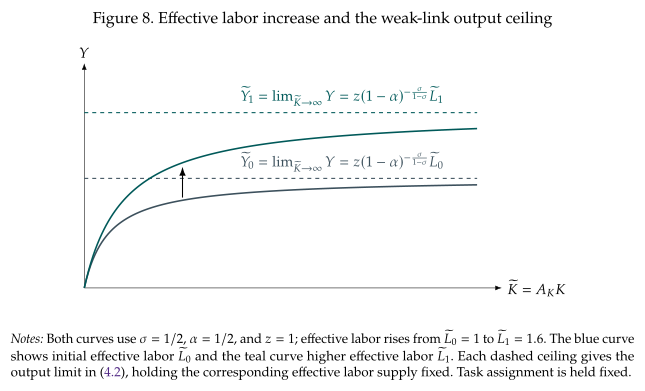
Now consider an extreme experiment. Capital becomes arbitrarily productive at the tasks it already performs, so \(\widetilde{K}\,\rightarrow\,\infty\), while the assignment of tasks stays fixed. However, capital and labor are not very substitutable, so that \(0\,<\,\sigma\,<\,1\). So, even though \(\widetilde{K}\) grows without bound, aggregate output remains bounded
This is because with \(0\,<\,\sigma\,<\,1\) we have \(\frac{\sigma-1}{\sigma}\,<\,0\) and \(\widetilde{K}^{\frac{\sigma-1}{\sigma}}\,\rightarrow\,0\).
Figure 8 shows why better machines alone cannot remove the weak link. At a fixed level of effective labor, more effective capital moves production along a curve toward its horizontal ceiling. Raising effective labor lifts that ceiling: improving the remaining labor tasks, or supplying more labor, relaxes the bottleneck itself. The dashed lines are the weak-link limits in (4.2), not additional production possibilities at finite capital.
What is this capturing?
The low substitutability between capital and labor means that labor tasks are weak links in production (as in a chain that is only as strong as its weakest link). Producing the capital tasks at negligible cost (because of infinte productivity) does not eliminate the need to perform the tasks that remain with labor and are hard to substitute for. In the special case \(\sigma\;=\;1/2\), \(\widetilde{Y}\;=\;\frac{z\widetilde{L}}{1-\alpha}\).
How costly are weak links?
We can measure how costly the weak links are for growth by measuring the gap between current output and the limit output under infinite capital productivity. It turns out that the answer depends only on the capital share \((\alpha_K)\) and the elasticity of substitution \((\sigma)\), not on the level of technology or the physical supplies of capital and labor. To see this, recall that we can express the capital share as \(\alpha_K\,=\,\alpha\left(\frac{z\widetilde{K}}{Y}\right)^{\frac{\sigma-1}{\sigma}}\). Then, from equation (4.2) we obtain
If the capital tasks that are being improved command a small share of expenditure (low \(\alpha_K\)) and \(\sigma\) is low, even an enormous productivity improvement in those tasks can generate only a modest increase in aggregate output.
What happens to input shares?
As capital becomes infinitely productive at its tasks the share of expenditure going to capital and labor can change. When capital and labor are hard to substitute for each other, the share of income going to capital end up falling as its productivity rises, with ever more expenditure going to labor. Holding the task partition fixed,
The highly productive capital tasks become so cheap that their income share vanishes. This is the logic of Baumol's cost disease (Baumol 1967). When activities are hard to substitute for each other, the activities with slow productivity growth become relatively expensive and account for a growing share of expenditure.
The fixed task partition is an essential qualification in all of these results. Equations (4.2)--(4.4) describe capital becoming better at tasks it already performs. Automation can also expand the set of capital tasks. That extensive-margin change displaces labor from particular tasks and is the subject of lectures to follow.
\begin{tcolorbox}[enhanced,colback=white,colframe=cite_blue!50, boxrule=.5pt,sharp corners,title={Weak links: why automating some tasks is not enough}, colbacktitle=cite_blue!8,coltitle=cite_blue,fonttitle=\bfseries, before upper={\setstretch{1.15}}] A weak link is an essential activity that does not benefit directly from the productivity improvement brought up by AI and other technologies. These activities limit the gains from technological change elsewhere because other activities are poor substitutes for it. For example, faster record keeping does not replace the time needed to help a confused patient through the night; producing more software does not rewire an old building or run a kindergarten classroom. These are among the human activities highlighted by Jones and Tonetti (2026, Section~5.2). The issue is not that they can never be automated, but that they may remain difficult to improve while other tasks become much cheaper.
Weak links limit the growth that can come from productivity and automation. Consider software development, a sector that accounts for 2\% of GDP and where AI may eventually automate a large share of the work. Now imagine that AI makes software development infinitely productive (\(A_S\longrightarrow\infty\)). With an across-task elasticity of \(\eta=1/2\), their fixed-task calculation gives an output multiplier of \(1/(1-0.02)\approx1.0204\): a gain of only about 2\%, despite the unlimited improvement in software. The other 98\% of sectors not directly affected by AI still limit production.
History illustrates why progress must spread across tasks. This is what it takes for growth to take over. Jones and Tonetti describe combine harvesters replacing manual threshing, automatic elevators replacing elevator operators, software taking over typing and travel-booking tasks, and robots welding and painting cars. These changes extend the range of activities benefiting from improving machines. In the authors' historical counterfactual, freezing the set of automated tasks at its 1950 level while allowing machine productivity to keep improving eliminates 87\% of private-business TFP growth over 1950--2023. In their model, automation strengthens the remaining weak links by allowing more tasks to benefit from rapidly improving machines. Their historical counterfactual therefore suggests that improving machines on already-automated tasks would have generated much less growth than combining those improvements with the automation of additional tasks. \end{tcolorbox}
Stable factor shares can conceal extensive automation
We can illustrate the two opposing effects with a simple static task example, following Jones and Tonetti (2026, Appendix~B.3). Suppose equally weighted tasks combine with elasticity \(0<\sigma<1\). Capital performs a fraction \(\beta\in(0,1)\) of tasks and labor performs the rest. Within each group, productivity is the same across tasks: \(\psi_K\) for capital and \(\psi_L\) for labor. Capital is cheaper on the tasks it can perform; the remaining tasks require labor. Their unit costs are \(r/\psi_K\) and \(w/\psi_L\), respectively. CES task demand makes expenditure on each task proportional to its unit cost raised to \(1-\sigma\). Summing expenditures within each group therefore gives
Here \(\beta\) measures the fraction of automated tasks, whereas \(\alpha_K\) measures their share of expenditure. Holding \(r\), \(w\), and \(\psi_L\) fixed, log differentiation separates a change in task coverage from a change in machine productivity:
Both factor shares remain unchanged when
Automating more tasks shifts expenditure toward capital, while better machines make the capital tasks cheaper and reduce their expenditure share when tasks are hard to substitute for each other. These effects can exactly offset: stable factor shares can coexist with a larger fraction of tasks performed by machines. This compares static allocations at given factor prices; unchanged shares alone do not imply unchanged task assignments.

William J. Baumol (1922--2017): Why personal services become expensive
Baumol was an American economist who taught at Princeton and New York University, with major contributions to competition, entrepreneurship, and public policy. He was widely regarded by fellow economists as deserving of a Nobel Prize, although he never received one.
Note
See the Princeton obituary and Litan and Hathaway's 2017 assessment.
The cost disease. The issue Baumol wanted to understand is what happens when productivity growth is uneven across sectors of the economy. It was clear that the sector experiencing productivity growth could expand and pay more to its workers. But, what about the sectors that become (relatively) less productive?
The key to Baumol's answer is that the labor market connects the different sectors. So, productivity improvements elsewhere in the economy raise workers' outside earning opportunities. Because of this wages must rise to retain staff even in sectors that are not experiencing productivity growth. This makes the output of these sectors become more expensive relative to goods produced with rapidly improving technology. This is the cost disease: Rising productivity can make some goods and services more costly.
Baumol developed the argument with William Bowen in their study of the performing arts and extended it to other services (Baumol and Bowen 1966; Baumol 1967). William Nordaus (Nobel prize 2018) found that industries with slower productivity gains experienced rising relative prices and declining relative real output (Nordhaus 2008). Outside manufacturing, faster productivity gains were also associated with slower increases in employment and hours. This supports the distinction between becoming more expensive and producing relatively more.
Examples.
- Live music: a string quartet still requires four musicians for the duration of the performance, as it did in Mozart's time. Recordings reach larger audiences, but provide a different product.
- Teaching: individual tutoring, feedback, and classroom interaction require teachers' attention. Increasing class size can raise students per teacher while changing the service each student receives.
- Personal care: bedside nursing, helping an older person wash and dress, and a physician's examination require time with a person. Technology can improve particular tasks without eliminating that time.
Connection to weak links. When buyers cannot easily substitute away from these services, their rising relative prices can increase their share of expenditure, just as labor tasks gain expenditure share in our example. If buyers can substitute away, the service may instead contract. These patterns do not imply that all services have stagnant productivity, or that all increases in healthcare and education spending reflect cost disease: quality, demand, and institutions also matter.