David Ricardo and machinery: Capital substituting labor is a longstanding issue
Technological progress and capital accumulation were major concerns during Ricardo's lifetime during the early 19th century, as they are today two centuries later. Industrial machinery and rapid capital accumulation on the hands of a few raised urgent questions about changes the distribution of income among workers, capitalists, and landowners. Ricardo's essay On Machinery---added as Chapter 31 of the Principles' third edition in 1821---shows us how these topics were discussed back then:
"In the present chapter I shall enter into some enquiry respecting the influence of machinery on the interests of the different classes of society, a subject of great importance, and one which appears never to have been investigated in a manner to lead to any certain or satisfactory results."
Before this essay, Ricardo had argued that all technological progress would be beneficial to workers. This is the same conclusion we got from our analysis of the aggregate production function. Even if the share of income going to workers could decrease, capital accumulation and better technology would increase real wages and with them the standards of living of workers. He changed his mind on this:
"My mistake arose from the supposition, that whenever the net income of a society increased, its gross income would also increase; I now, however, see reason to be satisfied that the one fund, from which landlords and capitalists derive their revenue, may increase, while the other, that upon which the labouring class mainly depend, may diminish, and therefore it follows, if I am right, that the same cause which may increase the net revenue of the country, may at the same time render the population redundant, and deteriorate the condition of the labourer."
He gives a numerical example of this (in classical Ricardian fashion). He is thinking of a change in technology that diverts part of the labor previously producing food and necessaries towards building machines (capital). The capitalist retains a capital stock worth £20,000 (about 5 Million CAD in today's money). The capitalists invest £7,000 of this capital and that the remaining £13,000 is employed as circulating capital in the support of labour. The value of the goods produced is £15,000. Then, the capitalist decides to construct more machinery (say, data centers). For this they employ half of their labor; the other half produces just as before. Ricardo's argument goes as follows
"The machine would be worth £7,500, and the food and necessaries £7,500, and, therefore, the capital of the capitalist would be as great as before; for he would have besides these two values, his fixed capital worth £7,000, making in the whole £20,000 capital, and £2,000 profit [the same profit as before]. After deducting this latter sum for his own expenses, he would have a no greater circulating capital than £5,500 with which to carry on his subsequent operations; and, therefore, his means of employing labour, would be reduced in the proportion of £13,000 to £5,500, and, consequently, all the labour which was before employed by £7,500, would become redundant."
Net income (for the capitalist) can be maintained even though the resources employing workers shrink. Ricardo consequently takes workers' concerns seriously:
"That the opinion entertained by the labouring class, that the employment of machinery is frequently detrimental to their interests, is not founded on prejudice and error, but is conformable to the correct principles of political economy."
But he also stresses the timing and financing of investment:
"The statements which I have made will not, I hope, lead to the inference that machinery should not be encouraged. To elucidate the principle, I have been supposing, that improved machinery is suddenly discovered, and extensively used; but the truth is, that these discoveries are gradual, and rather operate in determining the employment of the capital which is saved and accumulated, than in diverting capital from its actual employment. [...] But with every increase of capital he would employ more labourers; and, therefore, a portion of the people thrown out of work in the first instance, would be subsequently employed"
Hollander (2019) provides a modern historical perspective on Ricardo's messages.
Our task model makes a related distinction using different machinery. A fall in \(r\) from capital accumulation, or a rise in \(a_K(i)\) from technological progress, can lower the cost of capital relative to labor in (5.8). If capital is technically capable of the task, assignment can shift toward machines. Lower production costs can expand output and demand for the labor tasks that remain. The balance determines wages and employment.
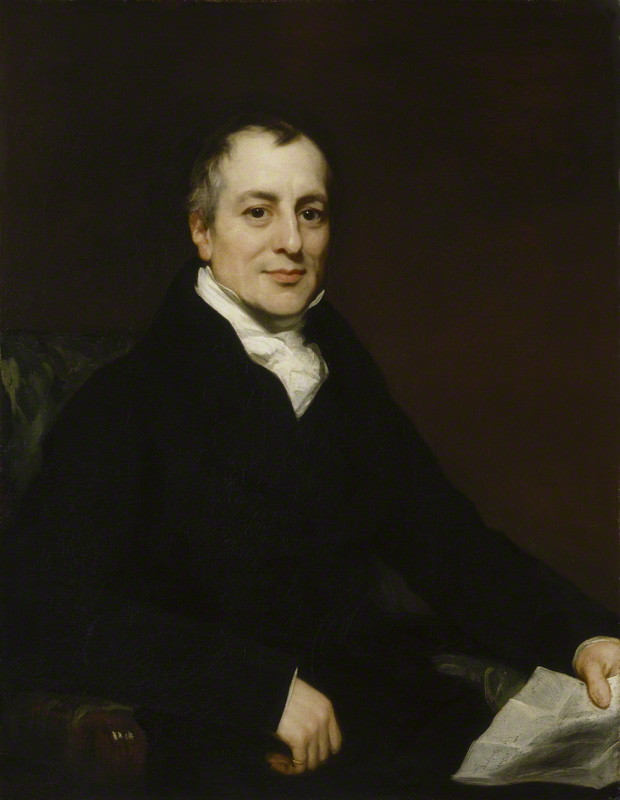
David Ricardo (1772--1823)
Thomas Phillips, c.~1821. Portrait source (public domain).

Ricardo was a British political economist, successful stockbroker, and Member of Parliament. His Principles (1817; third edition 1821) became a foundation of classical economics. He was a close friend of Thomas Robert Malthus and did much to develop economic thinking during the first industrial revolution.
Ricardo introduced many concepts still used in economics. The most famous is, no doubt, comparative advantage, but he also described what we now call Ricardian equivalence when thinking about the funding of government spending during the Napoleonic wars. Under strong conditions, replacing current taxes with debt leaves consumption unchanged because households save for the future taxes needed to service the debt; the modern formal benchmark is associated with Barro (1974).
Sources: Ricardo (1821); Ricardo (1821); *Principles, Ch.~17 (taxes and borrowing); *Letters to Malthus, ed.~Bonar (1887); National Portrait Gallery profile.