The Ricardian roots of task assignment
Why should a highly skilled worker leave any task to someone else if that worker can perform every task more quickly?
This is the same question that motivates David Ricardo's account of international trade: why should a country import anything if it can produce every good with less labor than its trading partner? The answer is that production entails an opportunity cost. Ricardo showed that the principle of comparative advantage takes into account the costs and benefits of the different alternatives firms and countries face when organizing production.
Absolute advantage and comparative advantage
A producer has an absolute advantage in a good when it needs fewer inputs to produce a unit of that good. It has a comparative advantage when its opportunity cost of producing the good is lower. In a two-good, one-factor Ricardian economy, let \(z_{cg}\) be the units of labor required to produce one unit of good \(g\) in country \(c\). The opportunity cost of one unit of good 1 is \(b_{c1}/b_{c2}\) units of good 2: the labor used for good 1 could instead have produced that amount of good 2. Thus country \(A\) has a comparative advantage in good 1 relative to country \(B\) if
Country \(B\) then has a comparative advantage in good 2. This can hold even when \(z_{A1}<z_{B1}\) and \(z_{A2}<z_{B2}\), so that \(A\) has an absolute advantage in both.
Trade example: England's cloth and Portugal's wine
Ricardo (1821, Ch.~7) illustrates the argument with the way England and Portugal traded back then. The key is understanding how relative productivities work in each country. We start from the productivity of labor in each activity (cloth or wine) and each country:
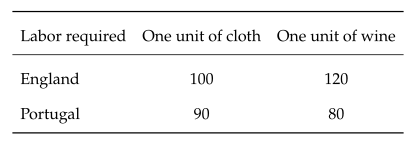
Portugal has an absolute advantage in both goods. But one unit of cloth costs England \(100/120=5/6\) units of wine and costs Portugal \(90/80=9/8\) units of wine. England therefore has a comparative advantage in cloth. Conversely, one unit of wine costs Portugal \(80/90=8/9\) units of cloth, compared with \(120/100=6/5\) in England. Portugal has a comparative advantage in wine.
To see the gains from trade, suppose one unit of cloth trades for one unit of wine, a relative price of \(1\) strictly between \(5/6\) and \(9/8\) units of wine per cloth. England can obtain wine by producing cloth with 100 units of labor and exporting it, instead of producing wine directly with 120. Portugal can obtain cloth by producing wine with 80 units of labor and exporting it, instead of producing cloth directly with 90. Both save labor. This price illustrates mutually beneficial exchange.
Ricardo makes the apparently surprising implication explicit in Ricardo (1821, Ch.~7, Portugal example); original passage:
"It would therefore be advantageous for her [Portugal] to export wine in exchange for cloth. This exchange might even take place, notwithstanding that the commodity imported by Portugal could be produced there with less labour than in England. Though she could make the cloth with the labour of 90 men, she would import it from a country where it required the labour of 100 men to produce it, because it would be advantageous to her rather to employ her capital in the production of wine, for which she would obtain more cloth from England, than she could produce by diverting a portion of her capital from the cultivation of vines to the manufacture of cloth."
From countries and goods to skills and tasks
Now replace countries with skill groups and goods with tasks. Consider two groups, \(H\) and \(L\), and two tasks: preparing an analysis and processing a record. Suppose their hourly productivities are
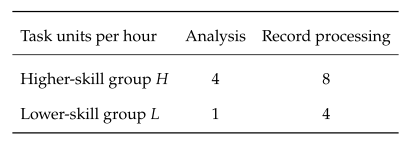
Group \(H\) is absolutely more productive at both tasks. But one "unit of analysis" costs \(H\) two processed records and costs \(L\) four. Group \(H\) has a comparative advantage in analysis, while \(L\) has a comparative advantage in record processing.
The comparative advantage argument becomes a firm's assignment decision through wages. If \(w_H=\$60\) and \(w_L=\$20\) per hour, the cost per analysis is \(60/4=\$15\) using \(H\) and \(20/1=\$20\) using \(L\). The cost per processed record is \(60/8=\$7.50\) using \(H\) and \(20/4=\$5\) using \(L\). Firms assign analysis to \(H\) and record processing to \(L\).
More generally, the specialization just described requires
For any two groups, our general assignment rule can be written as
Relative productivity gives comparative advantage and orders tasks; the relative wage determines the cutoff. Absolute productivity helps determine income levels.
Canonical models based on comparative advantage
- Ricardian trade. Ricardo's two-country example is formalized and extended to a continuum of goods by Dornbusch et al. (1977). Goods are ordered by relative labor requirements, and relative wages determine the specialization boundary. Eaton and Kortum (2002) extend Ricardian trade to many countries with stochastic productivities and geographic trade costs, providing a quantitative account of bilateral trade and gains from trade.
- Occupational choice and assignment. In Roy (1951), people choose occupations according to the earnings their different abilities command; selection depends on relative earning opportunities. Assignment models study how matching heterogeneous workers to heterogeneous jobs shapes output and wages; Sattinger (1993) surveys this tradition. Comparative advantage can therefore explain occupational sorting and observed earnings differences.
- Offshoring and task trade. Grossman and Rossi-Hansberg (2008) move the international allocation decision inside production: different tasks can be performed in different countries as offshoring costs change. Their framework combines task allocation with factor-endowment forces.
- Skills, automation, and new tasks. Acemoglu and Autor (2011) and Acemoglu et al. (2025) combine earlier task models with the continuum-of-goods Ricardian framework to determine assignment across skill groups. Acemoglu and Restrepo (2018); Acemoglu and Restrepo (2019) extend task allocation to capital and to the creation of new tasks in which labor has a comparative advantage. These models distinguish displacement from productivity and reinstatement effects.